Publications
2026
- Preprint
 Revisiting Speculative Leaderless Protocols for Low-Latency BFT ReplicationDaniel Qian, Xiyu Hao, Jinkun Geng, Yuncheng Yao, Aurojit Panda, Jinyang Li, and Anirudh Sivaraman2026Under review
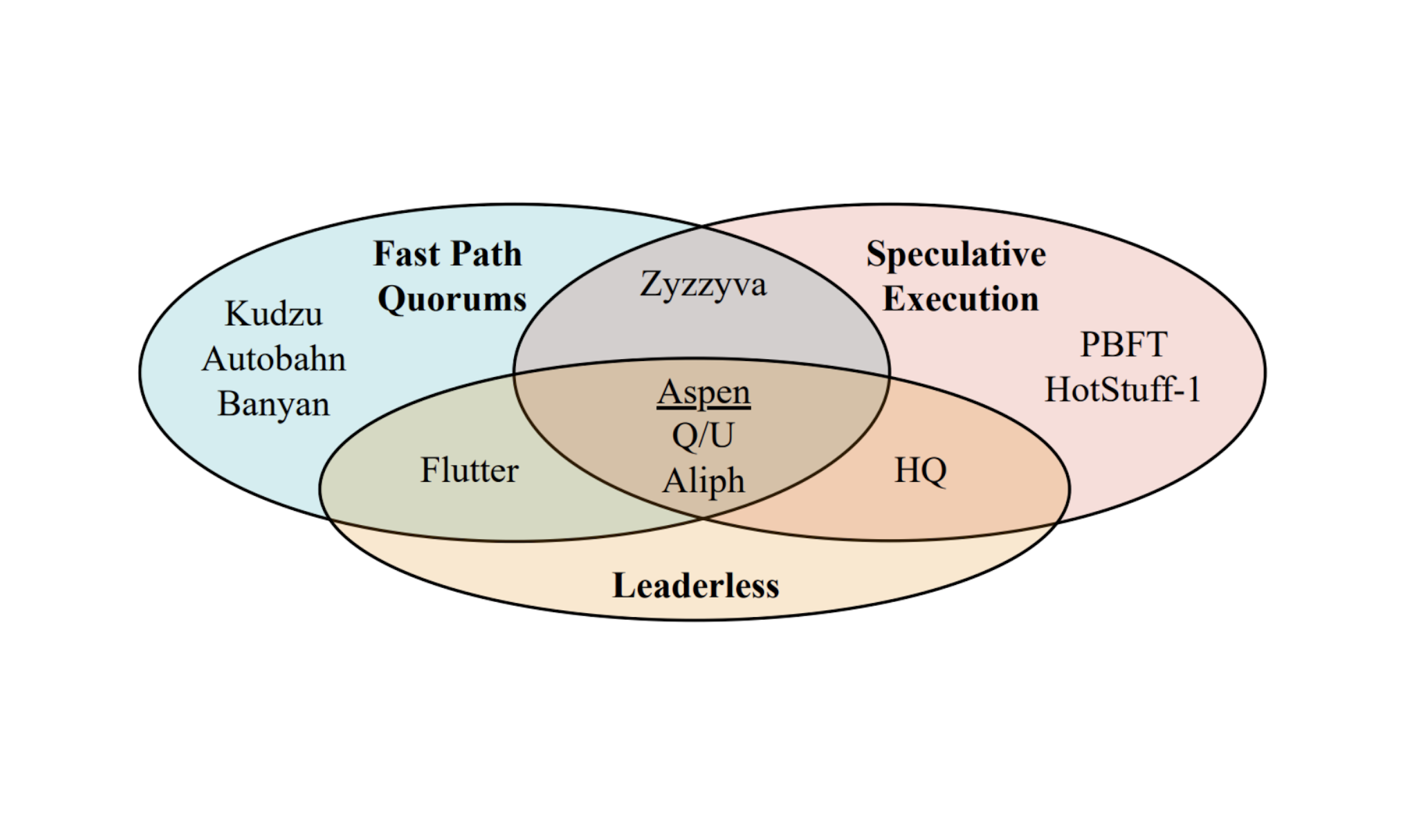
As Byzantine Fault Tolerant (BFT) protocols begin to be used in permissioned blockchains for user-facing applications such as payments, it is crucial that they provide low latency. In pursuit of low latency, some recently proposed BFT consensus protocols employ a leaderless optimistic fast path, in which clients broadcast their requests directly to replicas without first serializing requests at a leader, resulting in an end-to-end commit latency of 2 message delays (2Δ) during fault-free, synchronous periods. However, such a fast path only works if there is no contention: concurrent contending requests can cause replicas to diverge if they receive conflicting requests in different orders, triggering costly recovery procedures. In this work, we present Aspen, a leaderless BFT protocol that achieves a near-optimal latency of 2Δ+ε, where ε indicates a short waiting delay. Aspen removes the no-contention condition by utilizing a best-effort sequencing layer based on loosely synchronized clocks and network delay estimates. Aspen requires n=3f+2p+1 replicas to cope with up to f Byzantine nodes. The 2p extra nodes allow Aspen’s fast path to proceed even if up to p replicas diverge due to unpredictable network delays. When its optimistic conditions do not hold, Aspen falls back to PBFT-style protocol, guaranteeing safety and liveness under partial synchrony. In experiments with wide-area distributed replicas, Aspen commits requests in less than 75 ms, a 1.2 to 3.3× improvement compared to previous protocols, while supporting 19,000 requests per second.
2025
- SIGCOMM ’25
 Network Support For Scalable And High Performance Cloud ExchangesMuhammad Haseeb, Jinkun Geng, Daniel Duclos-Cavalcanti, Xiyu Hao, Ulysses Butler, Radhika Mittal, Srinivas Narayana, and Anirudh SivaramanIn Proceedings of the ACM SIGCOMM 2025 Conference, São Francisco Convent, Coimbra, Portugal, 2025
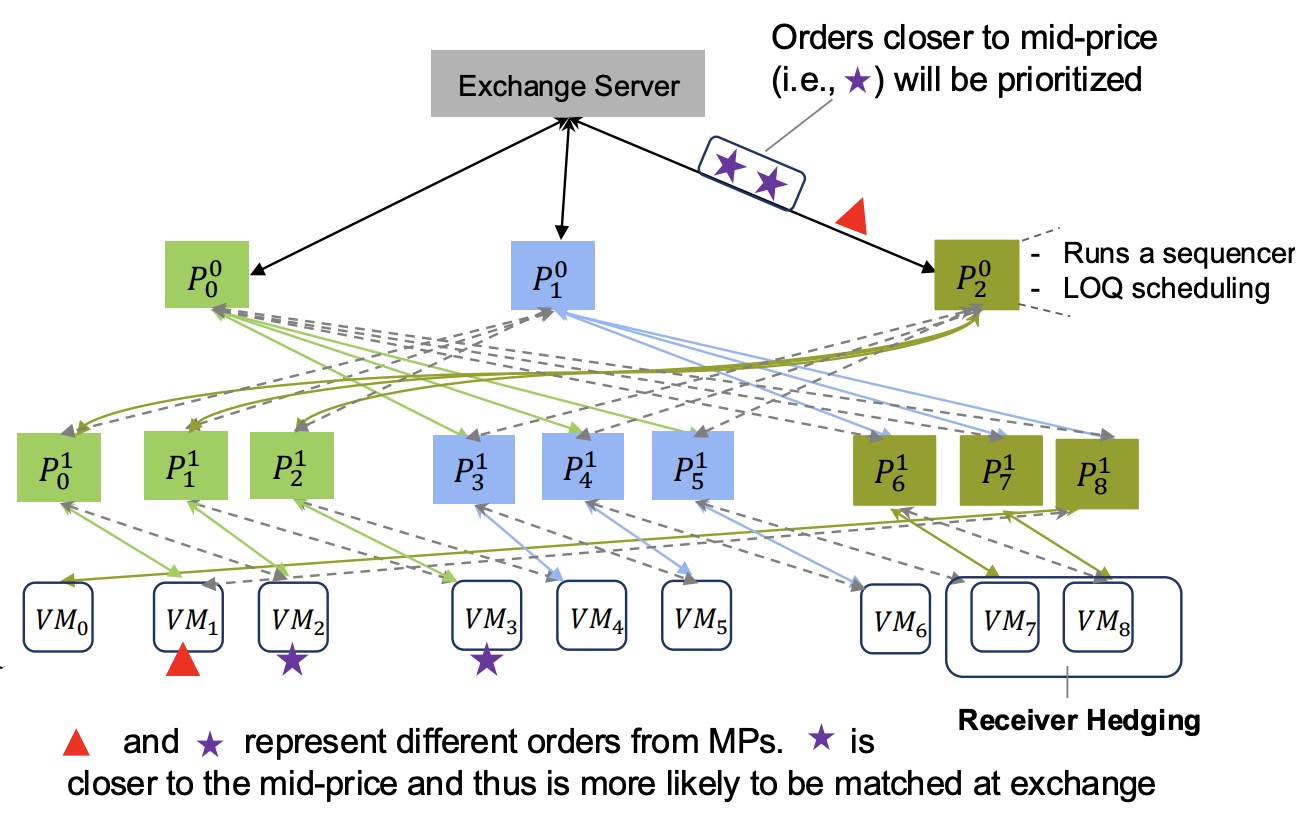
Financial exchanges are migrating to the public cloud, but the best-effort nature of the cloud fabric is at odds with the stringent networking requirements of the exchanges. We present Onyx, a system for meeting such requirements which uses many well-studied techniques in a new context as well as introduces new techniques that enable a scalable cloud financial exchange. An overlay multicast tree is used to disseminate data to 1000 participants with ≤ 1 μs difference in data reception time between any two participants, crucial for maintaining fair competition. Several techniques for mitigating latency variance are introduced. Onyx also presents a scheduling policy for trade orders that enhances an exchange’s performance and gracefully services bursty traffic. Onyx achieves ≈50% lower latency than the AWS multicast service [1]. Onyx outperforms an existing system, CloudEx [2] in terms of supported number of participants, exchange’s throughput and multicast latency. Onyx’s techniques can be applied to other existing systems (e.g., DBO) to enhance their performance.